Three Risk Factors for Developing Dementia That Did Not Make It Into the Lancet Report

In the previous chapter, you read an overview of the report by the international commission of The Lancet, which presented 14 modifiable risk factors directly linked to the development of dementia.
This list includes genuinely important aspects that should be taken into account when preventing dementia.
But there are several noticeable omissions. Despite the careful analysis, at least three critically important factors were left out of the discussion.
The Lancet commission made its choices based not only on science, but also on social and economic considerations.
Including these three risk factors would have required very serious discussions about revising entire sectors of the global economy.
Of course, this does not mean that science does not recognize the importance of these factors. Quite the opposite.
But while official documents avoid topics that touch deep economic interests, we remain in the risk zone.
So that, by inertia, we do not ignore important opportunities to protect brain health, in this chapter I want to clarify what these factors are, why they do not make it into the official agenda, and what key role they play in the development of dementia.
Here you will find a brief overview. In the following chapters, I will talk about each “untouchable” factor separately: the most important things to know, and what to do.
The Pharmacological Problem

Yes, it is not hard to guess that the first factor they officially chose not to touch is, of course, Big Pharma. But why exactly? Most people probably do not know.
It is now reliably known that many groups of medications may increase the risk of developing neurodegenerative diseases.
The paradox is that this especially concerns drugs prescribed to treat the very same dementia risk factors, for example:
- cardiovascular disease
- diabetes
- hypertension
- depression
and others.
Including medications in the list of risk factors would require enormous costs for reassessing existing treatment protocols and their possible consequences.
It would immediately trigger public debate and create challenges for the pharmaceutical industry, which, as we understand, is never interested in a paradigm shift.
High-Carbohydrate Nutrition

The direct link between the foods we feed ourselves and the neurodegeneration we feed into ourselves has already been deeply studied and demonstrated.
And these studies, one more convincing than the next, show that:
- the standard diet, high in carbohydrates and sugar, increases the risk of developing dementia and other cognitive impairments.
- blood sugar spikes damage blood vessels and disrupt insulin function — one of the causes of cognitive disorders.
- moreover, excess sugar may intensify inflammatory processes in the brain and accelerate the accumulation of beta-amyloid, a marker of Alzheimer’s disease.
Why was this factor not included in the official recommendations?
Because the entire food industry is built on the mass production of carbohydrates.
The foundation of most people’s diet is made up of cheap sources of calories.
Because the task is to feed everyone, provide jobs, keep the economy moving, and keep production going.

Even if we imagine that such a shift began to happen, it would undermine entire supply chains and destroy economic models that support billions of jobs around the world.
That is why research showing the frightening harm of carbohydrates for cognitive health is officially blurred. The Lancet commission chose to focus on factors that are already accepted and do not cause social and economic turbulence.

Expecting official organizations like the WHO to suddenly “lose it,” break off the leash, and start seriously saying that the entire modern food industry is a path toward catastrophic consequences for the human brain — that is utopia.
Sleep Culture

At first glance, the absence of sleep from the list of 14 Lancet risk factors seems even more puzzling.
Such a popular topic. Everyone talks about it.
A rare point of agreement across almost all areas of medicine: good health needs good sleep.
Neuroscience puts the question of sleep even more sharply: no sleep — no mind.
It is a critically important biochemical process.
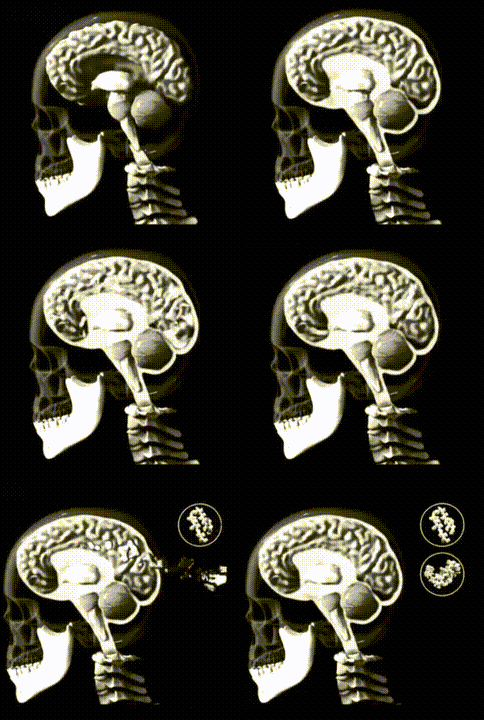
Sleep is the time when the brain clears out the metabolic waste accumulated during the day.
Through the glymphatic drainage system, toxins and metabolic byproducts are removed during sleep, including beta-amyloid — the companion of Alzheimer’s disease.
Without sufficient quality sleep, this process is disrupted, which leads to toxin accumulation and, in turn, contributes to the development of neurodegenerative diseases.
Scientific studies show that chronic sleep deprivation increases the risk of developing Alzheimer’s disease by 30–50%.
In addition, sleep disorders are linked to poorer cognitive function, lower concentration, weaker memory, and reduced overall mental flexibility.
And yet, the commission decided not to include sleep in its report, even though it is an obvious risk factor for the development of neurodegeneration.
This can be explained by several reasons.
Recognizing sleep as an important risk factor would require recommendations to change approaches to life, work, and infrastructure planning: night shifts, transport — aviation and railway operations alone, plus their maintenance. And then there are the police, fire services, hospitals, and much, much more.

And the number of people employed in these and related fields is hard even to imagine. This is a complex and long-term task requiring coordination at the level of governments and corporations. Let’s be honest: practically unsolvable.
In addition, there are many financial interests tied to the modern pace of life.

Media companies, energy drink manufacturers, pharmaceutical companies offering stimulants...
All of them are interested in maintaining the existing state of affairs.
So, the Scientific Data Is Clear:
- low-carbohydrate nutrition,
- quality sleep,
- and a conscious attitude toward medication
can really and significantly reduce the risk of developing dementia.
Someone else’s social and economic motives should not obscure the facts for you.
You have the opportunity to know this information, instead of drifting with the current.
Neither The Lancet, nor the clinic, nor an expert from a YouTube podcast carries responsibility.
You are responsible for yourself and for your loved ones.
Study and act — everything you need for that is here.