Nothing Suggested What Was Coming…
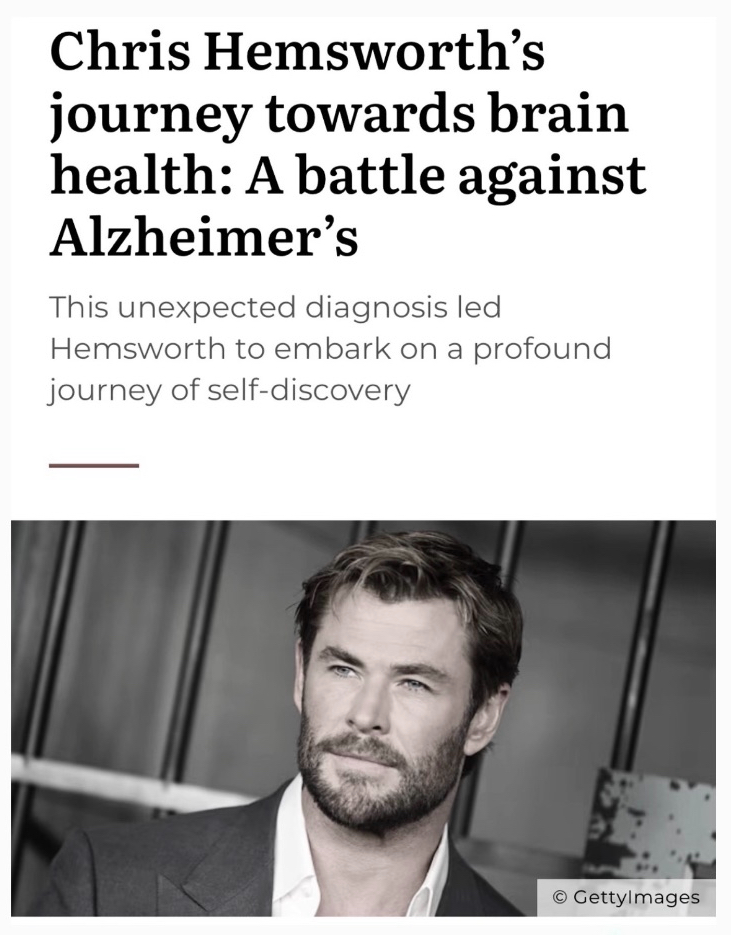
A famous actor at the peak of his career.
A blockbuster star from the Marvel universe.
The face of global brands.
When National Geographic invited Chris Hemsworth to its much-talked-about reality show about the limitless possibilities of the human body, for him it was just another job. Nothing suggested what was coming.
The test revealed that he had two copies of the APOE e4 gene. One of the main genetic provocateurs of Alzheimer’s disease.
During filming, he had to take a genetic test.
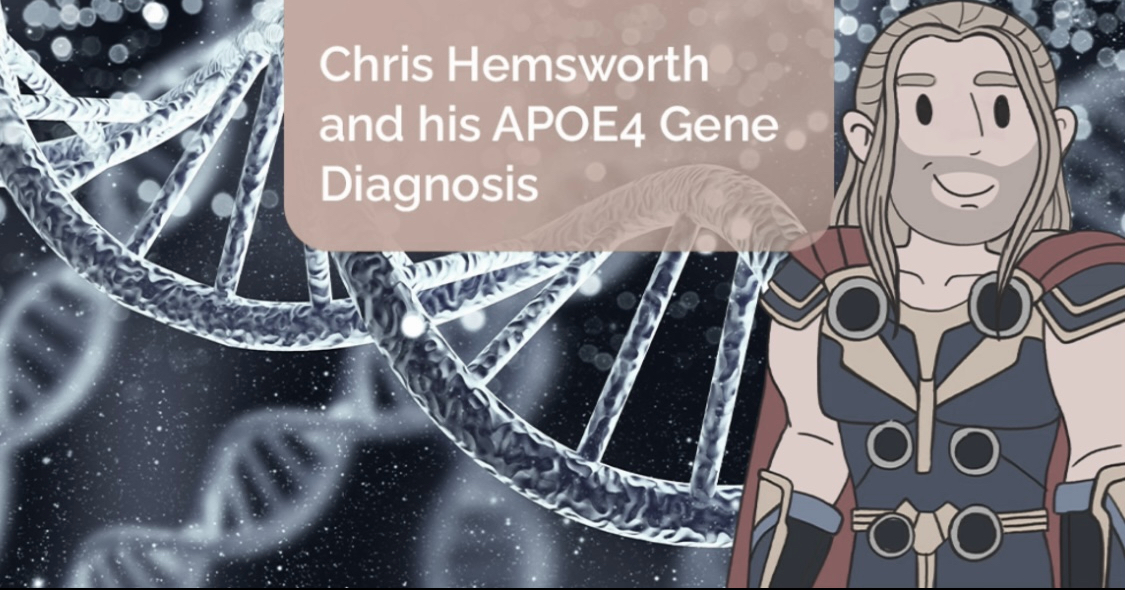
One copy from his father, the other from his mother.
A negative jackpot in the genetic lottery.
This is real genetic bad luck. The risk of developing the disease shoots up roughly 10–15 times.
The APOE E4 Gene
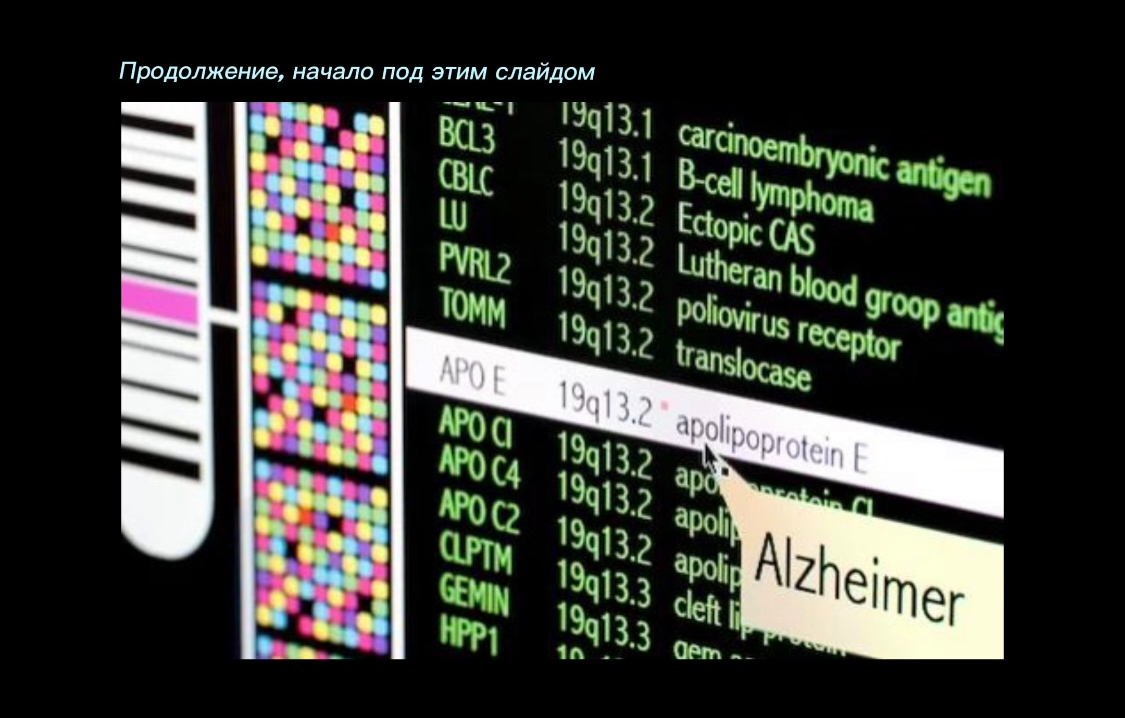
The APOE gene exists in three different variants: APOE E2, APOE E3, and APOE E4.
APOE E2 and APOE E3 are considered safe.
APOE E4 is considered dangerous.
About 25% of people have one copy of it. This means that at least one in five people reading this right now is a carrier.
If, without APOE e4, the risk of Alzheimer’s by age 80 is 20%, then:
- with one copy of APOE e4, the risk rises to 47%.
- with two copies of APOE e4, the risk increases to 91%.
If one of your close relatives has been diagnosed with dementia, the “check engine” light is blinking on your dashboard.
You can ignore it — as I did. I’ll explain why later.
Or you can take a genetic test — Apolipoprotein E Genotyping. It is absolutely not a given that you have this gene if there was an Alzheimer’s diagnosis in your family history.
And even if it is found, remember: this is not a diagnosis. It is an increased risk that you have learned about in time, and that you can fight.
There Are Even More Dangerous Genes That Cause Dementia
Luckily, they are quite rare
We are talking about the APP, PSEN1, and PSEN2 genes.
These mutations are also inherited.
And if the APOE e4 gene is like one wrongly written word in one place in the instruction manual, then mutations in these genes mean the entire technical operating documentation is wrong.
And the chance of developing the disease is 50/50 — heads or tails.
For Those Who Have Only “Heard a Thing or Two” About Genes
In very simple terms, you could put it like this: if you imagine the body as a factory, then every process in that factory has to run strictly according to instructions.
Genes are those very instructions — only for how the body functions.
Sometimes “typos” creep into these instructions, as if autocorrect had been turned on.
Most of these “typos” are harmless. But sometimes they can cause very serious failures and break the whole production system.
Why I Won’t Take the Test for the APOE E4 Gene

Knowing whether the gene is there or not does not change what matters.
Despite my family history, I will not be checking for APOE e4.
There are things I control. Genetics is not on that list.
Real control is in how you organize your life: how you train your body, how you develop your brain.
Not believing in predictions, but creating the conditions for a healthy brain for as long as possible.
That is my strategy.
I cannot advise anyone to do the same.
For some people, a similar decision will turn into inaction — and that is the worst thing you can “plant” for your own future.
For others, learning about the risk would be like discovering a crack in the windshield that is not going anywhere. And the truth may turn out to be stronger than their belief in themselves and their will to resist it.
For others still, this kind of extreme knowledge may become an alarm clock. A serious reason to pull their head out of the well-known place and study how to protect themselves.
Whatever decision is made, it is important to know the following:
- The absence of APOE e4 does not guarantee that the disease will pass you by. About 42% of people with Alzheimer’s disease do not have this gene.
- The presence of APOE e4 does not mean you will definitely get sick.
And neither the first nor the second changes what needs to be done.
Genes are just a clue.